
Casino No ID Verification UK: What Checks to Expect
 Available in GB
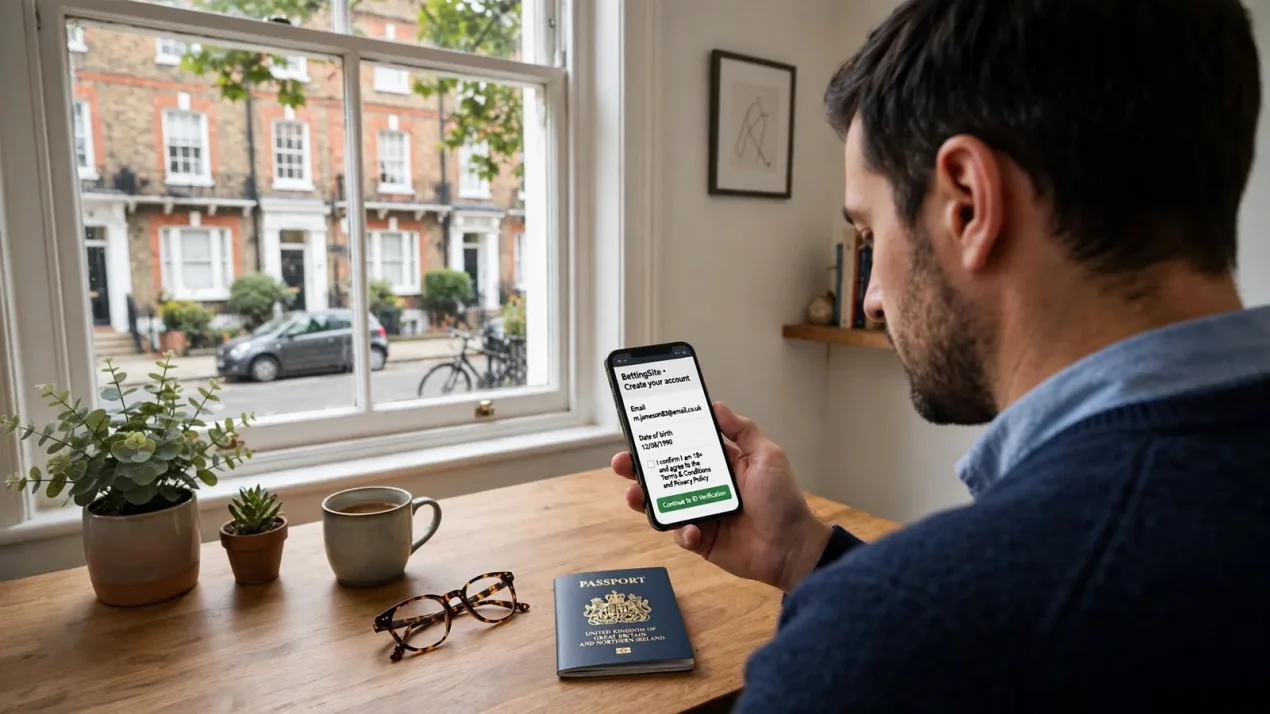
A low-paperwork sign-up does not mean checks are waived; UK rules require age and identity verification before gambling.
What “No ID” Means Before You Play
“No ID” can sound like a promise that a casino will let you play without checking who you are. That is not a safe assumption. In practice, the label often refers to when a check takes place, or to whether you are asked to upload documents as soon as you register. It does not establish that checks will never happen.
For online gambling in Great Britain, the important point is the timing required by the rules: a business must verify your age and identity before you gamble. The UK Gambling Commission requires these checks before a customer is allowed to play. A site’s description of itself as an online casino with no ID verification cannot cancel that requirement.
This matters because “no ID” is used loosely. It may describe a sign-up process that appears to involve little paperwork, rather than an account that is permanently exempt from identity checks. A casino may not ask you to provide documents at the first step, but that alone does not tell you whether it will check your details before you can gamble. Nor does a claim of “no photo ID” establish that the operator will accept no other form of verification, or that it will never ask for evidence.
The wording also leaves out what the operator means by “ID”. Some readers understand it as a request to upload an identity document; others take it to mean any check of their age or identity. Those are not the same idea. A check may be conducted without an immediate document upload, but the absence of a request on the registration screen is not proof that your age and identity have been verified. The relevant question is not simply whether a site asks for a document at sign-up. It is whether it completes the required checks before you gamble.
Casino Sites and Safety for UK Players
That distinction is useful when assessing claims about an online casino with no ID needed in the UK. A site may advertise a lighter registration process, but the phrase does not tell you the full sequence of events. “No ID required” might mean that a document is not requested at the outset; it should not be read as a guarantee that the account will never be checked. If the wording is not clear about when verification happens, it is not a reliable promise about what you will be asked to do.
It is also worth separating the marketing phrase from the rule. The requirement is about verifying age and identity before gambling, not about whether a casino uses the words “no ID” in its advertising. You should not treat a smooth-looking sign-up as evidence that the operator has completed those checks, or as permission to start playing without them.
Searches for a casino with no ID check often reflect a practical concern: people want to know whether they can register and play without being asked for paperwork. But the label alone cannot answer that. A site might delay a request for documents, or use “no ID” to emphasise that the initial process is less visible to the customer. Neither interpretation means that the check is permanently waived. If an operator’s claim appears to say otherwise, it conflicts with the requirement that age and identity be verified before gambling.
The same caution applies to phrases such as “best no ID casino” or “real-money casino with no ID verification”. Those descriptions can make a site sound as though it offers unrestricted play, but they do not change what verification is required. A ranking or promotional label is not evidence that a player can gamble without the necessary checks. The word “best” is especially unhelpful here: it says nothing about whether the operator’s process is clear or when you may be asked to complete it.
For you as a reader, the practical distinction is between “not asked for documents immediately” and “never checked”. The first may describe the order in which a process happens. The second is a much broader claim, and the phrase “no ID” does not prove it. A casino might let you create an account before requesting evidence, but registration by itself is not the same as permission to gamble.
Attention: A "no ID" label often describes the sign-up experience rather than a permanent exemption from identity checks. The requirement to verify age and identity before gambling remains mandatory.
So, when you see “no ID” attached to an online casino, read it as a claim about the sign-up experience unless the operator clearly explains more. Do not take it as assurance that you can play without age and identity verification. The check must happen before gambling; the timing and practical details can vary, but the label does not remove the requirement.
UK-Licensed and Offshore Casinos Are Not the Same
A casino’s licence tells you which regulator oversees its operation; it is not just a label on its website. A UK Gambling Commission (UKGC) licence places an operator serving the British market within the UK regulatory system. A casino licensed overseas is overseen under a different jurisdiction and does not hold that UKGC licence. That distinction matters when you consider what protections and arrangements apply.
For operators offering remote gambling to customers in Great Britain, a UKGC licence is required. The legal position for players is separate: a UK resident may play at a casino licensed abroad if the operator is not unlawfully targeting the UK market. That does not make an overseas licence equivalent to a UK one, or mean that the casino is regulated by the UKGC. The regulator responsible for the operator is the one named by its licence.
This is why the phrase “no ID casino” can blur two different issues. It may describe a site’s approach to checks, but it says nothing by itself about who regulates the business. Nor does an overseas licence establish that a casino will never request information from a customer. If you are assessing a site, establish which regulator issued its licence and verify the licence number on that regulator’s public register before depositing. A site’s own wording is not a substitute for checking the regulator’s record.
Non-GamStop Curacao Casino Sites: UK Guide
What GamStop coverage tells you
GamStop is the UK’s national online self-exclusion scheme. UK-licensed operators are required to connect to it. If you register with GamStop, participating UKGC-licensed gambling businesses must apply the exclusion; the scheme is not simply a setting that each casino can choose to ignore.
A non-GamStop casino is generally a site without a UKGC licence, so it is not part of that national database. Overseas operators are not required to integrate with GamStop. That is the practical limit of the scheme’s coverage: it applies to participating UK-licensed operators, not every gambling website that someone in Britain can reach.
This point should not be mistaken for a recommendation to use an offshore casino instead. If you have chosen self-exclusion, looking for a site outside the scheme undermines the boundary you set. Non-GamStop does not mean safer, more private, or free from checks; it identifies a difference in licensing and self-exclusion coverage. An overseas operator may still have its own account rules, and its regulator is not the UKGC.
What a foreign licence does—and does not—mean
A foreign licence means the casino is operating under the rules of the jurisdiction that issued it, rather than under UKGC oversight. It does not establish that the operator has no regulation at all. Equally, the existence of a licence does not give you the same route or protections as dealing with a UK-licensed business. The relevant regulator and its register matter more than a broad claim that a site is “licensed”.
A casino’s licence identifies the regulator overseeing its operation; a UKGC licence places an operator within the UK regulatory system, whereas an overseas licence means it is overseen by a different jurisdiction.
The UK distinction is particularly relevant to searches for no-ID casino sites. Some sites may promote limited checks at registration or describe themselves as no-KYC, but those claims do not determine whether the operator is licensed to serve the British market. A foreign licence does not turn a casino into a UKGC-licensed casino, and a “no ID” description does not change the regulator responsible for it.
There is also a difference between being able to access a site and the operator being permitted to target customers in Britain. UK residents’ ability to play at certain foreign-licensed casinos does not remove the requirement for operators selling into the British market to hold the relevant UK licence. Avoid treating availability as proof of UK authorisation. The licence and the operator’s status should be checked, not inferred from a site loading or accepting an account.
The useful comparison, then, is not simply “UK casino versus no-ID casino”. It is UKGC oversight and GamStop participation on one side, and an overseas regulator with no obligation to connect to GamStop on the other. That tells you who oversees the operator and whether the national exclusion scheme applies. It does not promise that an offshore site will skip verification, and it does not make non-GamStop a way to get around a self-exclusion.
Can You Play Slots Without Verification?
A slot labelled “no ID” does not give you an exemption from identity checks. For real-money play in Great Britain, the rule applies to the game as well as the account: the UK Gambling Commission requires an online gambling business to verify your age and identity before you gamble. A slot is not a separate route around that requirement.
The wording usually points to the timing of a check, not its absence. A site may let you register or browse before asking for documents, but that does not mean you are cleared to play real-money slots without verification. At a UK-licensed casino, checks are generally part of the process before gambling can begin. UKGC-licensed casinos almost always require verification at some stage; “no ID needed” should not be read as a promise that they will never ask.
What the label can mean
“No ID” can be used loosely to describe a sign-up process that does not immediately ask you to upload documents. It may also refer to automated checks, which can verify details electronically without a manual document request at that point. Neither interpretation means that the operator has waived its duty to establish who you are and how old you are before you gamble.
That distinction matters when you see claims about slots with no verification. A registration page may appear quick, and the slot lobby may be visible, but access to a game or account is not proof that the required checks are complete. Read the claim as a description of the operator’s process, not as a guarantee about what it can ask you for later.
The timing may differ between operators. UK-licensed sites often complete full checks before the first deposit, while offshore sites may delay fuller checks until a later stage. That difference can make an offshore slot site look less demanding at the outset, but it does not establish that checks will never happen. The underlying distinction is when verification takes place, not whether it exists.
Do
- Confirm the operator’s licence before registering
- Read the verification terms before depositing
- Treat “no ID” as a description of the process timing
Don’t
- Assume a quick sign-up means no checks are required
- Treat availability as proof of UK authorisation
- Rely on a slot’s headline as a guarantee of no-KYC play
Real-money slots are still gambling
If you are staking money on a slot, the fact that it is a digital game does not change the age and identity requirement. Nor does choosing a particular slot, opening it through a mobile browser or using a different payment method turn the play into something outside the rules. The relevant point is whether you are gambling for money, not how quickly the game loads or how the operator describes its sign-up.
You may encounter free-play versions of slots. A game that lets you try its features without staking money is different from playing a real-money version, but it should not be confused with permission to gamble without checks. If you move from a demo to real-money play, the verification requirement applies before that gambling begins.
Searches for “slots no ID needed real money” can therefore lead to a misleading impression. A real-money slot that is genuinely available to a customer in Great Britain cannot be made exempt from the age and identity rule by branding or by a delayed document request. Claims of play first and no checks ever deserve particular caution.
What to check before opening a slot
Look at the operator behind the game, rather than relying on the slot page’s headline. Confirm that the casino is properly licensed to serve the British market and read its verification terms before registering or depositing. A UKGC licence is the relevant authorisation for an operator serving customers in Great Britain; an overseas licence is not a substitute for it.
Also distinguish seeing a slot from being entitled to play it for money. A site might display games before it has completed checks, but the display itself does not confirm that you can lawfully begin gambling there. If an operator suggests that real-money slots are available with no age or identity checks at all, treat that as a warning about the claim, not a special feature of the game.
For a UK player, the practical answer is straightforward: you may encounter slot sites that postpone asking for documents, but “no ID” does not mean “no verification”. Before you stake money, the operator must have verified your age and identity.
Why Withdrawals Can Trigger an ID Check
A withdrawal request can be the point at which a casino asks you to prove who you are. Some offshore operators postpone a full identity check until a player tries to cash out, rather than completing it when an account is opened. That timing can make a site appear to offer play without checks, but it does not mean the check has been waived.
For British players, the distinction matters. Online gambling businesses serving Great Britain must verify age and identity before a customer gambles. A later check at withdrawal is not a substitute for that requirement. Nor does a “no-KYC” label establish that you can withdraw without documents: most non-GamStop casinos still ask for identity documents before approving a withdrawal.
Approval is not the same as payment
A withdrawal has two stages. First, the casino reviews and approves the request. It may pause that stage while it checks identity or other account details. Only after approval does the payment move to settlement, when the chosen payment service or bank processes the transfer.
Withdrawal Process Stages
A withdrawal involves two distinct stages: first, the casino reviews and approves the request (which may be paused for identity checks), and second, the payment is settled by the bank or payment service.
These stages can take different amounts of time. A casino may approve a withdrawal while the money is still being processed by the payment provider. Conversely, a payment cannot proceed if the casino has put the request on hold pending verification. If a site gives you a processing estimate, check whether it refers to its own approval or to the time for the money to reach you.
This is why “withdrawal pending” does not necessarily explain what is happening. Read the status and any message in your account, and contact the operator if the reason for a delay is unclear. Keep copies of the request and the operator’s replies.
Limits can slow access to a large win
Identity checks are not the only possible obstacle. Withdrawal limits can restrict how much an operator releases over a stated period, so a large balance may be paid in stages rather than all at once. A specialist review has reported monthly withdrawal caps at offshore casinos; this should be treated as a reported practice, not a rule that applies to every operator. Check the casino’s withdrawal terms before depositing, including any limits and the conditions for requesting payment.
A limit and a verification hold are different. A limit controls the amount or pace of payment; a verification hold prevents approval until the operator is satisfied with its checks. Both can affect when you receive winnings, and one does not explain away the other.
If a casino markets itself as a no-ID withdrawal option, look beyond the label. The practical question is whether its terms say what documents may be required and what happens if a check is opened when you request payment. A request for verification at that stage can delay access to your balance, even when the account previously appeared ready to play.
What “No ID Casino UK” Can Honestly Promise
A “no ID” claim can describe a delay in asking for documents, not a promise that you will never be checked. In practical terms, a site may let you register or begin an account process before requesting full identity information. That is different from being allowed to gamble without age and identity checks.
For customers in Great Britain, the UK Gambling Commission requires online gambling businesses to verify age and identity before a customer gambles. UK-licensed casinos therefore cannot treat “no ID” as an exemption from that requirement. They often complete full KYC—the checks used to establish a customer’s identity—before the first deposit.
The timing can differ at sites operating outside the UK regulatory system. Offshore casinos commonly postpone full checks until a first cashout is requested. That may make the initial steps feel less demanding, but it does not mean checks will not happen. A casino can still ask for verification before approving a withdrawal, and a “no ID” label does not guarantee that you will be able to access winnings without providing information.
There is also an important distinction between a site being accessible and being authorised to serve the British market. Remote gambling operators selling into Great Britain must hold a UK Gambling Commission licence, regardless of where they are based. A foreign licence does not replace that requirement. So a site’s claim that it accepts UK customers should not be confused with confirmation that it is licensed to do so.
No ID Meaning
"No ID casino" refers to when a site asks for checks—not whether those checks are required by law.
For a UK reader, then, “no ID casino” is best read as a claim about when a site may ask for checks—not whether checks apply at all. At a UK-licensed casino, verification is generally dealt with early because it must be completed before gambling. At an offshore site, the request may come later, often when you seek to withdraw. The difference is timing, not a reliable right to play or cash out anonymously.
If a site presents the phrase as a guarantee that no identity checks will ever be required, treat that wording cautiously. It cannot remove the UK rules that apply to licensed operators, and it cannot make an offshore operator’s later verification request disappear. The convenient part is fewer checks at the outset; the inconvenient part is that the request can arrive when access to your balance matters.
Real-Money Games and Crypto Do Not Remove Checks
Paying with cryptocurrency does not make real-money gambling exempt from identity checks. The payment method may change how money moves, but it does not change the UK requirement: online gambling businesses serving customers in Great Britain must verify age and identity before those customers gamble. A site’s claim that you can play casino games without ID should not be read as permission to avoid checks altogether.
The timing can differ between operators. Some offshore casinos may not ask for full KYC—short for “know your customer”—when you register. That does not mean there will be no later review. They may use eKYC, or electronic identity checks, to assess details automatically, including without asking you to upload documents at sign-up. A check can therefore happen in the background or at a later point in your account activity.
Crypto does not prevent that. A casino accepting Bitcoin or Ethereum may still carry out an automated check, and it may still ask you to verify your identity. Treat “crypto casino” and “no verification” as separate claims: one describes a payment option; the other concerns the operator’s checks. Neither a crypto deposit nor a successful first game proves that an account will never be reviewed.
Withdrawal speed is also a separate issue from verification. Specialist reviews report that cryptocurrency withdrawals at some offshore operators can be processed in minutes, while a specialist review of serious offshore operators gives a timeframe of one to six hours. These are reported processing times, not a guarantee for a particular casino or transaction. The figures describe what may happen when a withdrawal is processed; they do not establish that the operator has skipped its checks.
That distinction matters if you are comparing real-money casinos that accept crypto. A fast transfer does not tell you whether identity checks were completed, whether an automated review took place, or whether the operator may request further verification later. The payment can move quickly and the account can still be subject to checks. Crypto is not an invisibility cloak; it is a way of making a payment.
Cryptocurrency is a payment method and does not act as an invisibility cloak; operators may still use electronic identity checks (eKYC) in the background or request verification later.
Before depositing, read the operator’s terms for its verification requirements and check who regulates it. If a site advertises no-KYC play, look for what it says about account reviews and withdrawals rather than relying on the label. For a UK reader, the key point is straightforward: using real money or cryptocurrency does not remove the requirement for age and identity checks, and a rapid crypto payment should not be mistaken for proof that no checks apply.
No-Deposit Bonuses Still Come With Conditions
A no-deposit bonus may sound like a way to try a casino without paying in first. It does not mean you can gamble without checks, or that any winnings will be paid without them. The promotional label describes how an offer is presented; it does not determine when an operator verifies your identity.
This matters when an offer is advertised as a no-deposit bonus with no ID verification. “No ID” may mean that the casino does not ask for documents at registration, not that it will never ask. UK-licensed and offshore sites can differ in the timing of checks: some offshore operators defer full verification until a withdrawal, while UK-licensed sites often check earlier. A later check is still a check.
A bonus balance is not the same as money you can withdraw. Before accepting an offer, read its terms and look for what the casino says about eligibility, play-through conditions, identity checks and withdrawing any winnings. If those details are unclear, the headline is not enough to tell you what you will be able to do with the bonus. Do not assume that a small or promotional balance removes the operator’s ability to verify you.
The same applies to crypto-related promotions. Depositing or receiving funds in cryptocurrency does not turn a promotional offer into an exception to identity checks. A casino may conduct checks automatically or ask for verification later, even if the offer is described as no-KYC. The payment method and the timing of a check are separate issues.
For a UK reader, there is an additional distinction: a remote operator offering gambling to customers in Great Britain must hold a UK Gambling Commission licence. An offshore promotion does not become a UK-licensed offer because it is available to a UK visitor or is described as “no deposit”. UK-licensed operators must verify age and identity before you gamble, so a promise that you can use a bonus first and avoid checks altogether should not be treated as reliable.
In practical terms, “no deposit” may describe the way a promotion starts; “no ID” may describe when a check is requested. Neither phrase establishes that the offer has no other conditions, that you qualify, or that a withdrawal will be approved without verification. Check the operator’s licensing status and the full promotion terms before registering. If the offer makes the absence of checks sound guaranteed, treat that claim with caution: delayed verification is not the same as no verification.
What a Casino May Ask You to Verify
“No ID” does not tell you what information an operator might later ask for. A specialist review of no-KYC casinos describes checks that can cover identity, address, contact details and the source of your funds. That is a report of possible requests, not a promise that every operator will ask for the same things.
Identity Checks
Verification of whether the account belongs to the person using it.
Address Checks
Verification of where the account holder lives.
Source-of-Funds
Verification of where the money used for gambling originated.
Identity checks concern whether the account belongs to the person using it. Address checks concern where that person lives. Contact details may be checked to confirm that the operator can reach the account holder. A source-of-funds check concerns where the money used for gambling came from. These are distinct parts of a review; a request about one does not automatically mean that the others have been completed.
Read any request carefully and check which category of information it concerns. If a casino asks for details, use its official account or support channels rather than sending personal information through an address or link you cannot verify. The operator should make clear what it needs and how to submit it securely.
The scope can matter as much as the label on a site. An operator described as a no-KYC casino may still ask for information beyond a basic identity check. Before sharing anything, check that the request comes from the casino you registered with, understand what it is asking you to provide, and keep a record of the communication.
You should not assume that a request is limited to proving your name, or that a site’s “no ID” wording rules out questions about your address, contact details or funds. If the reason for a request is unclear, ask the operator to explain it before sending sensitive information. A broad label on a casino’s page cannot tell you in advance exactly what information an individual account review may cover.
Our top casino picks for the UK
- ChanzeBonus: Slots Welcome Bonus #1 200% up to €500 · Payout speed: 1-3 business days
- NightWinBonus: £900 + 400 free spins · Payout speed: 1-3 business days
- Revery PlayBonus: 100% up to€1,000+ 100 FS · Payout speed: 1-3 business days
- WinBeastBonus: €5000 + 500 FS + €650 Freebet · Payout speed: 1-3 business days
- EvoSpinBonus: 125% up to €2500 + 125 Free Spins · Payout speed: 1-3 business days
- BritsinoBonus: Welcome Package – Get your £2,200 + 2,000 FS · Payout speed: 1-3 business days
- AmunbetBonus: Join now and get 450% up to 2,700 GBP + 450 FS · Payout speed: 1-3 business days
- SlotoSportBonus: 500% up to £ 10 200+ 777 FS · Payout speed: 1-3 business days
- BeOnBetBonus: 100% up to €500 + 100 FS · Payout speed: 1-3 business days
Free Spins Do Not Guarantee Play Without Checks
Free spins can make a slot available as part of a promotion, but they do not change the rules for who may gamble. In Great Britain, an online gambling business must check a customer’s age and identity before that customer gambles. A free entry point is still part of gambling when it lets you play a slot.
No-Minimum-Deposit Casinos in the UK: £1 Guide
That matters if you are looking for free spins with no deposit and no ID verification. The absence of a payment at the start does not create an exception to the age and identity requirement. Nor does a promotional label mean that you can play first and avoid checks altogether.
A casino may present a free-spins offer before you have completed its checks. That is not the same as permission to use the spins without verification: the operator must meet the requirement before you gamble. If a site suggests that free spins remove the need for age or identity checks, treat the claim with caution.
Read the offer’s conditions, but keep the central distinction clear: free spins describe how play is offered, not whether checks apply. They are not a route to anonymous slot play. A promotion can be an entry point to a game; it cannot override the rules that apply to the operator.
Pay by Mobile: Deposits Are Not Withdrawals
Paying through your mobile phone can make depositing straightforward, but it does not mean you can receive winnings the same way. At offshore casinos, Boku and similar mobile-payment services are described as deposit-only: the charge goes onto your phone bill or is taken from your prepaid balance, while withdrawals need another payment route.
A specialist review reports this limitation for mobile payments at offshore platforms. Availability can vary by operator, so check the cashier’s payment terms before you deposit. Look specifically for whether the method is listed for deposits, withdrawals, or both; seeing a logo at the deposit stage does not establish that it supports cashing out.
If mobile payment is deposit-only, you will need to use a withdrawal method the casino accepts. That can affect whether you can access funds through a route you already use, so consider the available cashout options before transferring money. The casino’s cashier or payment terms should set out the permitted methods.
Keep the distinction clear: a mobile payment is a way to fund an account, not a promise of a matching withdrawal service. If the information is unclear, ask the operator to confirm the available withdrawal routes before you proceed.
How do I verify that an offshore casino is properly licensed?
Check which regulator issued the casino’s licence and look up its licence number on that regulator’s public register. An overseas licence is not the same as a UK Gambling Commission licence.
How long does it take to get the money?
After the casino approves a withdrawal, cryptocurrency can take minutes or typically one to six hours, while Skrill and Neteller withdrawals at established offshore operators typically clear within 24 hours. Bank transfers may incur fees, and withdrawal limits or verification can delay access to your money.
What are the best payment methods for non-GamStop casinos?
At established offshore casinos, Skrill and Neteller are options for withdrawals, and cryptocurrency withdrawals can be quick. Check fees and limits before depositing: bank transfers can carry withdrawal fees, mobile payments such as Boku are deposit-only, and PayPal is essentially unavailable on genuine non-GamStop sites.
Related posts

Terms of Use

UK Casino Sites and Slots: Licensing and Play