
Casino Kings Complaints UK: Dispute Resolution and ADR Process
 Available in GB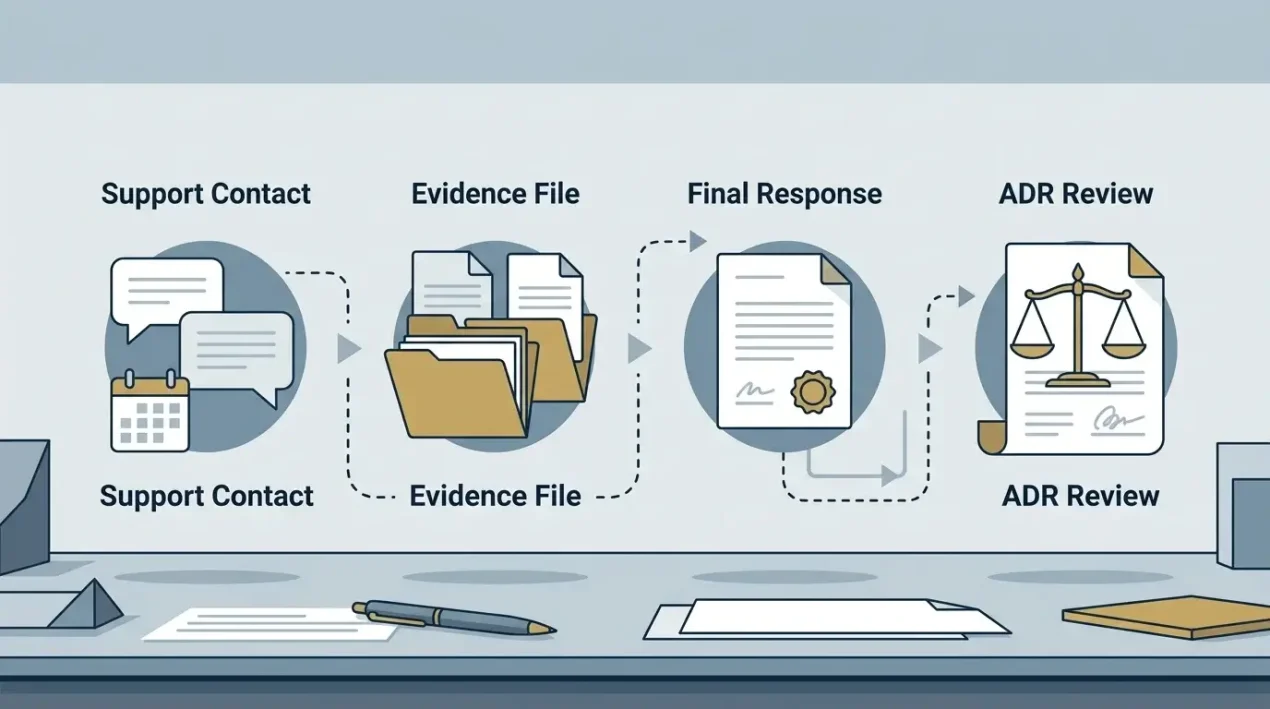
If a Casino Kings account, withdrawal, KYC or bonus issue cannot be resolved through standard support, UK players have a defined route. The operator is required to handle the complaint within eight weeks under UKGC LCCP rules, and after that point – or after a written deadlock letter – the matter can be escalated to an independent Alternative Dispute Resolution (ADR) provider. The Gambling Commission itself does not arbitrate individual disputes. This page maps the practical sequence and the documentation that supports it.
Casino Kings Support and Formal Complaint Procedures
The first contact for any unresolved issue is the operator. Casino Kings publishes two practical contact routes: 24/7 live chat when logged in, and email at [email protected]. For most account questions – a delayed withdrawal, a verification status check, a bonus that did not credit, a login issue – live chat is faster, and the chat log can be kept as documentation if the matter later escalates.
If standard support cannot resolve the issue, ask explicitly for the formal complaint procedure. Casino Kings, as a UKGC-licensed operator under ProgressPlay account 39335, has to publish a complaint procedure and follow LCCP rules on handling. The formal complaint is a different track from a casual support exchange; it triggers the operator’s published escalation path, the eight-week deadline and the option to receive a written final response or a deadlock letter. Use the formal route in writing where possible, even if you opened the matter on chat originally. For the wider operator and licence context, see the licence and trust checks guide.
Our top casino picks for the UK
- ChanzeBonus: Slots Welcome Bonus #1 200% up to €500 · Payout speed: 1-3 business days
- NightWinBonus: £900 + 400 free spins · Payout speed: 1-3 business days
- Revery PlayBonus: 100% up to€1,000+ 100 FS · Payout speed: 1-3 business days
- WinBeastBonus: €5000 + 500 FS + €650 Freebet · Payout speed: 1-3 business days
- EvoSpinBonus: 125% up to €2500 + 125 Free Spins · Payout speed: 1-3 business days
- BritsinoBonus: Welcome Package – Get your £2,200 + 2,000 FS · Payout speed: 1-3 business days
- AmunbetBonus: Join now and get 450% up to 2,700 GBP + 450 FS · Payout speed: 1-3 business days
- SlotoSportBonus: 500% up to £ 10 200+ 777 FS · Payout speed: 1-3 business days
- BeOnBetBonus: 100% up to €500 + 100 FS · Payout speed: 1-3 business days
The eight-week complaint and ADR sequence
The standard UK sequence for a licensed online casino complaint has three stages.
- Stage one – operator support. Raise the matter with Casino Kings support. Keep dates, transaction references, payment-method details, bonus names, support transcript screenshots and any cashier-screen captures.
- Stage two – formal complaint. If support has not resolved the matter, request the formal complaint procedure in writing. The operator is required to handle it within eight weeks. The output of stage two is either resolution, a written final response you accept, or a final response you disagree with (sometimes called a deadlock letter).
- Stage three – ADR escalation. If the matter is unresolved after eight weeks, or you have a deadlock letter sooner, the complaint can be referred to an approved independent ADR provider. The operator should tell you which ADR provider handles its disputes and supply the contact details; this is an LCCP requirement, not a courtesy.
The Gambling Commission monitors how operators handle complaints but does not arbitrate individual cases. A complaint to the Commission can inform regulatory action against an operator over time, but it does not result in a binding ruling on an individual account dispute. ADR is the route for an individual binding outcome.
Document everything before escalating
The strongest complaint file is boring and complete. Before opening a formal complaint, gather the documentation that supports it. The aim is for an ADR adjudicator (or a senior operator complaint handler) to be able to reconstruct what happened from the documents alone, without needing your interpretation. Include only what is relevant; avoid sending sensitive personal data beyond what the dispute requires.
A typical Casino Kings complaint file covers:
- The Casino Kings account identifier or username used for the dispute.
- Dates of the relevant transactions, deposits, withdrawals and bonus opt-ins.
- Amounts and currencies (Casino Kings UK accounts are in GBP).
- Payment method used, and partly masked screenshots if a payment record is relevant.
- Bonus name and opt-in time if a promotion is part of the dispute.
- KYC upload dates and the document categories submitted.
- Support conversation transcripts or screenshots, with dates.
- Cashier-screen screenshots showing the relevant transaction or status.
- The final response or deadlock letter, if received.
Do not send full card numbers in screenshots; mask all but the last four digits. Do not include unnecessary personal data on third parties. A clean file with redaction shows ADR adjudicators that you have prepared seriously without exposing private details that the dispute does not require.
Withdrawal complaints
Withdrawal-side complaints are the most common type at any UK-facing operator. Casino Kings publishes a £5 minimum withdrawal and a processing fee capped at £3 per transaction; the official content says withdrawal times vary by method and that additional identity verification can be required. None of those points alone is grounds for a complaint, because they are operator-published facts; the complaint position arises when a withdrawal request does not progress within the operator’s published process or when a request is rejected without a clear reason tied to those facts.
For a withdrawal complaint, document the cashier transaction ID, the method, the amount, the date the request was made, any operator messages about the status, the verification position at the time of the request, and any bonus state that might have affected processing. For the wider cash-out picture, the withdrawal guide covers the published flow, fees and timing wording; for the verification side, the identity checks explained page covers what Casino Kings can request and why it can pause a cash-out.
KYC, locked account and registration complaints
KYC-side complaints generally fall into three buckets: a verification request that has not progressed despite documents being submitted, a documents-rejected loop where uploads are refused multiple times without specific reasons, and a locked account where access is suspended pending review. The complaint position requires the operator to have a published procedure for verification and for account locks; Casino Kings, under LCCP, does have those procedures.
For a verification-side complaint, document upload dates and document types (without sending the documents themselves a second time), the operator’s stated reasons for rejection (if given), the dates of any account-status changes and the support transcript discussing the issue. Use the formal complaint route if the upload loop continues past what feels reasonable; do not open a second account in parallel, because multi-account use is a separate terms violation that can complicate the existing dispute.
Bonus and free-spins complaints
Bonus complaints often arise from the gap between marketing wording and the full terms. The current Casino Kings welcome offer is 100 free spins on a £20 qualifying deposit, with 10x wagering on free-spin winnings within 7 days and a £30 maximum conversion; Skrill and Neteller deposits are excluded, and a withdrawal request voids active or pending bonuses. The complaint position is rarely about the offer itself; it is usually about whether a player met the published conditions, or about how the operator applied a specific term.
For a bonus-side complaint, document the offer wording as it appeared on the day of opt-in (live-screen screenshot is best), the deposit method, the amount, the opt-in timestamp, the spin and stake history, and any cashier interaction. The terms of the offer at the time of opt-in are the binding version, not a later revision. For the welcome offer terms in detail, see the welcome offer details page.
ADR scope and limits
Approved ADR providers for UK licensed gambling can review and rule on individual disputes between an operator and a customer, with the operator usually required to comply with the outcome. ADR is free for the player to use. The ADR process is documentary – the adjudicator works from the file each side submits – and is generally quicker and cheaper than court action.
ADR is not a route to compensation beyond what the dispute actually warrants, and it does not adjudicate matters that fall outside the operator’s terms and the LCCP framework. ADR will look at whether the operator followed its own published terms, whether those terms align with LCCP and consumer-protection rules, and whether the player was treated fairly under both. If the ADR provider rules in the player’s favour, the operator typically has to pay back funds, credit a bonus or correct an account record; if it rules against the player, the player retains the option of court action, but the ADR ruling is usually persuasive in any later proceeding.
Public reviews as research, not as proof
Public review pages and forum threads can be useful research before opening a complaint. If multiple recent reviews mention the same withdrawal-method delay or the same KYC documentation pattern, that is a signal worth investigating in your own account. It is not proof of fault, and it is not a substitute for the operator’s published process and the LCCP framework.
Use public reviews to identify what to document early in your own dispute, not to argue on volume. ADR adjudicators work from your specific file, not from sentiment elsewhere on the internet. The reputation checklist covers how to read public comments alongside operator and regulator evidence; the FAQ and decision checklist covers the broader corrective answers around no-KYC and GAMSTOP intent that sometimes appear in complaint-adjacent searches.
Primary source links for complaint checks
Useful public records for the Casino Kings complaint route include the Gambling Commission complaint guidance, the UKGC ProgressPlay licence summary, the Casino Kings terms and conditions, the Casino Kings homepage and the operator’s published complaint procedure inside the Help area on the official site.
Casino Kings complaints FAQ
When should I move from support to a complaint?
Move to the formal complaint route when support has not resolved the issue in a reasonable time, when a written final response or deadlock letter has been issued, or when the matter is a documented dispute that needs the LCCP procedure rather than informal chat.
How long does the operator complaint process run?
Casino Kings has to handle complaints within eight weeks under UKGC LCCP rules. After eight weeks without resolution, or after a deadlock letter, the matter can move to an approved ADR provider.
What evidence should I keep?
Account identifier, dates, amounts, payment-method details, bonus name and opt-in time, KYC upload times, support transcripts and screenshots of the relevant cashier or offer screen. Mask full card numbers in screenshots.
Can the UK Gambling Commission rule on my dispute?
No. The Commission monitors how operators handle complaints and can take regulatory action, but it does not adjudicate individual customer disputes. ADR is the route for an individual binding outcome.
Does ADR cost anything?
ADR is free for the player to use for UK-licensed online gambling. The operator usually has to comply with the ADR ruling.
This material was created by the Casino Kings UK Guide team.
Related posts
Terms of Use
UK Casino Sites and Slots: Licensing and Play