
Non-UK-Regulated Casinos: Licensing and Risks
 Available in GB

The guide explains what UKGC authorisation covers and how it differs from permission issued by an overseas regulator.
UK-Regulated Online Casinos: What the Licence Covers
A UK Gambling Commission licence is the relevant authorisation for an online casino offering gambling to customers in Great Britain. The operator’s location does not change that requirement: a company based overseas still needs a UKGC licence if it serves the Great Britain market. Conversely, being based in the UK does not, by itself, establish that a casino is licensed and regulated here. The key point is which market the operator serves and whether it holds the appropriate UK authorisation.
The licence places the operator within the UK Gambling Commission’s regulatory system. That is what “UK-regulated” means in this context: the casino’s authority to serve customers in Great Britain comes from the UK regulator, rather than solely from a government or licensing body elsewhere. The distinction is about regulatory oversight, not the language on a website, the currency displayed or the country where the company has an office.
A casino may describe itself as licensed without holding a UKGC licence. The word “licensed” alone does not tell you which authority issued the permission or which market it covers. A licence from another jurisdiction and a UK Gambling Commission licence are separate authorisations. One does not automatically stand in for the other. So when you see a casino described as licensed and regulated, the useful question is: licensed and regulated by whom, and for which market?
This also explains the meaning of a non-UK-regulated casino. It is a gambling site operating outside the UK Gambling Commission’s oversight. It may have a licence from an authority in another country, but that does not make it a UK-regulated online casino. The terms can sound similar in marketing, yet the regulatory status is not interchangeable. “Overseas-licensed” describes where a licence may come from; “UK-regulated” identifies oversight by the UKGC.
The distinction matters because licensing is not a single worldwide system. Authorities issue permissions under their own rules and for the markets they cover. A foreign licence therefore cannot be read as proof that an operator has met the UKGC’s requirements or has permission to serve customers in Great Britain. Nor does a UKGC licence mean that every service offered by a company in every country falls under UK regulation. The licence relates to the operator’s regulated activity in the relevant market.
Non-UK Registered Casinos: Licences and Risks
Great Britain and the United Kingdom are not always interchangeable in regulatory descriptions. The UKGC requirement discussed here concerns operators serving customers in Great Britain. That scope matters when a site uses broad wording such as “available in the UK” or displays a UK-facing page. General availability is not the same as evidence of UKGC authorisation. A reader assessing the status of a casino should look for a clear connection between the operator, its UKGC licence and the service being offered.
It is also worth separating the existence of a licence from assumptions about what it guarantees. A UKGC licence identifies the regulator overseeing the operator’s relevant activity; it is not a promise that every transaction or customer interaction will be trouble-free. In the same way, an overseas licence should not be treated as equivalent merely because a site presents it prominently. Regulatory status is a specific fact, not a general endorsement of a brand.
When deciding which online casinos are licensed and regulated in Great Britain, the central distinction is therefore straightforward: the operator must hold a UK Gambling Commission licence to serve that market. A company’s headquarters, branding or claim to hold some form of licence does not remove that requirement. If the casino instead operates without UKGC oversight, it falls outside the category of UK-regulated online casinos, even if it has been authorised elsewhere.
This is the baseline for understanding the phrase “non-UK-regulated casinos” in 2026. It does not necessarily describe a site with no licence at all; it describes one that is not regulated by the UK Gambling Commission. That difference should be kept clear whenever a casino’s licensing status is discussed. An online casino licensed outside the UK and one licensed by the UKGC may both use the word “licensed”, but they do not have the same regulatory standing in Great Britain.
Can UK Players Use Casinos Licensed Abroad?
The legal position of a player is not the same as the rules imposed on a gambling operator. The Gambling Act 2005 is directed at businesses that provide gambling services to the UK market; it does not make an individual player the target of the Act simply for using a site licensed elsewhere.
British law does not specifically forbid a citizen from using a gambling service licensed in another country, nor does a player commit a criminal offence under UK law merely by gambling on a site that lacks a UK licence.
That distinction matters, but it is not an endorsement of non UK regulated casinos accepting UK players. A casino may hold permission from another country and still operate outside the UK regulatory system. The fact that its website is reachable from Britain, or that it accepts a registration from a British customer, does not establish that it is authorised to serve the UK market.
For players, the position is narrower than a simple “legal” or “illegal” label suggests. British law does not specifically forbid a citizen from using a gambling service licensed in another country. Nor does a player commit a criminal offence under UK law merely by gambling on a site that lacks a UK licence. Those points concern the player’s criminal liability; they do not turn an unlicensed service into a UK-authorised one.
The operator’s position is separate
The Act places the relevant licensing obligation on operators supplying gambling services into the UK market. A company’s overseas licence may regulate its activity under the rules of the jurisdiction that issued it, but that is a separate question from whether the operator is entitled to serve customers in Britain. A licence from abroad is not a substitute for UK authorisation.
This is why a site’s own description of itself should be read carefully. “Licensed” can refer to a permission issued elsewhere, not approval by the UK Gambling Commission. If a site accepts customers from Britain, its accessibility alone does not settle whether its conduct complies with UK requirements. The legal responsibility described by the Act falls on the operator, rather than being transferred to the customer.
Non-Gamban Casinos in the UK: Rules and Limits
What you should establish before using a site
Before depositing, check the law that applies where you live and the terms under which the service is offered. The United Kingdom’s legal framework is not identical across every part of the country: the Gambling Act 2005 applies in England, Wales and Scotland, but not Northern Ireland. If you are in Northern Ireland, do not assume that a statement about the Act’s scope in Great Britain answers the question for your location; check the rules that apply there.
You should also distinguish between the operator’s claimed licence and the practical terms governing your account. Read the site’s conditions and privacy information, and make sure you understand which company is providing the service and which jurisdiction’s rules it relies on. A foreign licence may give you a route to raise concerns under that jurisdiction’s arrangements, but it does not create a UK complaints route or make UK protections apply. Those differences can matter if the operator changes its terms, refuses a transaction or disputes your account.
Do not treat the absence of a criminal offence for the player as evidence that every consequence is settled. It says something specific about the player’s position under UK criminal law; it does not guarantee that a foreign operator will accept a British customer, that a dispute will be resolved in your favour, or that the service is authorised for the UK market. You remain responsible for checking local law and understanding the implications of using a gambling service based abroad.
Do not rely on marketing language as a legal answer if the site’s status or the law applying to you is unclear.
Searches for offshore casinos for UK players can blur these separate issues. A site may be accessible, and a player may not face criminal prosecution simply for using it, while the operator remains outside the UK licensing framework. Treat those as different questions. If the site’s status or the law applying to you is unclear, do not rely on its marketing language as a legal answer.
Casinos Outside GamStop: What That Means for Your Protection
GamStop is the UK’s online gambling self-exclusion scheme. A casino that is not part of it will not receive a GamStop exclusion as an instruction to close or restrict your account. That means registering with GamStop does not, by itself, prevent you from accessing a site outside the scheme.
This is the central protection gap. Self-exclusion works only across participating operators. If you are trying to stop gambling, a casino outside GamStop may remain available even after you have taken the step of excluding yourself from UK-licensed sites. The name “casinos outside GamStop” describes their relationship to the scheme; it does not mean they provide an equivalent system of their own.
Safeguards may differ
UK-licensed operators must provide responsible-gambling measures under the UK regulatory framework. A casino operating under a licence from elsewhere may face different requirements, and its rules on player protection may be less demanding. Do not assume that tools familiar from UK sites will be present, work in the same way, or apply across every account.
Online Casino No Registration UK: Access Explained
In particular, you should not rely on a non-UK-regulated casino to offer the same mandatory controls as a UKGC-licensed operator. Check the site’s own terms and responsible-gambling pages before opening an account, but treat a listed tool as a site-level feature, not as a replacement for GamStop. If you have self-excluded because gambling is causing harm, another casino’s promise of account controls is not a dependable substitute for staying away.
Data protection is another area where the standard may differ. A site outside UKGC oversight may be subject to a different set of requirements for handling personal information. Read its privacy policy to understand what it says about collecting, storing and sharing data. The presence of a policy does not, on its own, establish that the protections match those required of a UKGC-licensed operator.
Complaint options are narrower
Using a casino outside the UK system also means losing access to UK routes that would otherwise be available to customers of regulated operators. Players at offshore casinos cannot turn to the UK’s Financial Ombudsman Service in the way they can in matters within its remit. Nor should you expect the UK Gambling Commission to resolve an individual dispute with a casino that is outside its regulatory system.
That can leave you relying on the operator’s own complaints process and whatever avenues exist under the site’s licensing arrangements. Those are not necessarily equivalent to UK protections. Before depositing, find the complaints procedure and consider what it actually promises: who reviews a complaint, how the operator communicates its decision, and whether there is an independent body to which you can escalate it. If those details are unclear, resolving a disagreement may be harder.
Protection Gap
If you have self-excluded via GamStop, a casino outside the scheme may remain available, as your exclusion does not reach operators not participating in the system.
Keep copies of the terms, account messages and relevant transaction records if you choose to use a site. This is sensible record-keeping, not a guarantee that a complaint will be accepted or resolved in your favour.
A practical boundary
Searches for Curaçao casinos not on GamStop often combine two separate features: a casino’s licensing location and its absence from the UK self-exclusion scheme. Neither tells you, on its own, what protections the operator provides. The important point for your safety is that GamStop does not cover the site, while UK mandatory responsible-gambling tools and complaint routes may not be available there.
If you have used GamStop to manage your gambling, do not treat access to a non-participating casino as a loophole that leaves your exclusion intact. It means the exclusion does not reach that operator. Where gambling feels difficult to control, avoid opening another account and seek support from a recognised service such as GamCare.
Where Non-UK-Regulated Casinos Are Licensed
A non-UK-regulated casino may hold a gambling licence issued outside the United Kingdom. Jurisdictions commonly associated with these sites include Malta, Curaçao, Gibraltar and Anjouan. The licence identifies the authority under which an operator says it is permitted to work; it does not, by itself, establish that the casino is overseen by the UK Gambling Commission.
These places should not be treated as a single regulatory category. They are separate jurisdictions, and a licence from one is not interchangeable with a licence from another. Nor does the name of a jurisdiction tell you, on its own, which markets an operator is authorised to serve. A site’s stated licensing location is therefore a starting point for understanding its status, not a shortcut to deciding whether it can lawfully offer gambling to people in Great Britain.
VPN-Friendly Casinos in the UK: Access and Risks
For operators serving customers in Great Britain, the relevant distinction is whether they hold the required UK Gambling Commission licence. A foreign licence does not replace that requirement. So a casino may be licensed abroad and still fall outside UKGC oversight; the two descriptions are not competing labels for the same approval.
The jurisdiction named on a site can also be easy to misread. It may refer to the place that issued the licence rather than where the business is based, where its website is hosted, or where its customers live. Those details should not be inferred from a flag, a payment option or a phrase such as “internationally licensed”. The important point is which regulator is named and what that licence does—and does not—mean for the market the operator serves.
Malta, Curaçao, Gibraltar and Anjouan are thus useful names to recognise when you encounter claims about a non-UK regulated casino. They do not form a ranking, and their appearance in a casino’s terms does not show that the UK Gambling Commission has approved the site. In particular, a licence issued abroad should not be presented as permission to operate in Great Britain merely because the operator accepts a visitor from there.
The wording on a casino’s website may make its licensing status sound broader than it is. Read “licensed in” as a claim about the issuing jurisdiction, not as proof of UK regulation. If you are assessing a particular site, separate those questions: where does it say its licence comes from, and does it hold the UKGC licence required for serving Great Britain? An answer to the first does not settle the second.
Malta
A jurisdiction where some non-UK-regulated casinos hold licences.
Curaçao
A common licensing location for sites operating outside UKGC oversight.
Gibraltar
An overseas jurisdiction that issues gambling licences separate from the UKGC.
Anjouan
A licensing authority whose permissions do not authorize service in the UK.
Our top casino picks for the UK
- ChanzeBonus: Slots Welcome Bonus #1 200% up to €500 · Payout speed: 1-3 business days
- NightWinBonus: £900 + 400 free spins · Payout speed: 1-3 business days
- Revery PlayBonus: 100% up to€1,000+ 100 FS · Payout speed: 1-3 business days
- WinBeastBonus: €5000 + 500 FS + €650 Freebet · Payout speed: 1-3 business days
- EvoSpinBonus: 125% up to €2500 + 125 Free Spins · Payout speed: 1-3 business days
- BritsinoBonus: Welcome Package – Get your £2,200 + 2,000 FS · Payout speed: 1-3 business days
- AmunbetBonus: Join now and get 450% up to 2,700 GBP + 450 FS · Payout speed: 1-3 business days
- SlotoSportBonus: 500% up to £ 10 200+ 777 FS · Payout speed: 1-3 business days
- BeOnBetBonus: 100% up to €500 + 100 FS · Payout speed: 1-3 business days
What Can Go Wrong with Payments and Withdrawals
A deposit may be straightforward while a withdrawal becomes a separate test of the operator’s terms. At a non-UK-regulated casino, the time taken to receive winnings is not governed by a UK regulatory deadline. That leaves you dependent on the site’s own procedures if a payment is delayed or held for review.
Published accounts disagree sharply about how long withdrawals take. Some describe payments arriving within 24 hours to five business days; others warn that they can take three or four weeks. These are not interchangeable expectations, and neither gives you a guaranteed timetable for a particular site or transaction. The payment method, the operator’s checks and the terms attached to the account may all affect the process.
Read the withdrawal rules before depositing, not only when you request your money. Check whether the site sets daily, weekly or monthly withdrawal caps, and whether a larger balance must be paid in instalments. A specialist review has reported such limits at some operators, but they should not be assumed to apply everywhere: the relevant terms can differ between sites and change over time. Look for restrictions on the amount you can request, how often you can request it and whether a pending withdrawal can be cancelled.
Verification is another possible source of delay. An operator may ask for identity or payment documents before releasing funds. A specialist review has also reported requests for notarised documents or a video call at some offshore sites. Those steps are not evidence of a standard procedure across the market, but they show why it is worth checking what the operator says it may require. If a request arrives only after you try to withdraw, the account can remain under review while you gather the documents.
Keep copies of the site’s terms, your deposit and withdrawal records, and any messages about a payment. If the operator changes how it interprets a condition or gives no clear explanation for a delay, that record can help you understand what was agreed. It does not ensure the payment will be released, and using a casino not regulated by UKGC means you cannot rely on a UK regulatory clock to compel prompt handling.
Treat a withdrawal estimate as an estimate, not a promise. Before you play, consider whether you could tolerate a long wait, a request for further checks or a payment split under the site’s rules. If the terms are vague about withdrawals, or the operator will not explain them clearly, that uncertainty is itself relevant to deciding whether to deposit.
Crypto and Other Ways to Pay at Offshore Casinos
Payment options at a non-UK-regulated casino can differ from those at a UK-regulated casino. Some sites may accept bank transfers, e-wallets, credit cards or cryptocurrency, sometimes using payment processors that are not the ones a customer might expect. The options shown at registration or on a cashier page are specific to that operator; they should not be taken as a standard list for every site.
Cryptocurrency is a payment method, not a gambling licence. It does not determine who regulates a casino. That depends on the operator’s licensing arrangements, and using a digital currency does not bring a non-UK-regulated casino under UK Gambling Commission oversight. If a site claims to be regulated, check which authority it names and what the licence covers rather than treating the presence of crypto as evidence of regulatory approval.
There is also a UK credit-card rule to distinguish from an offshore operator’s payment choices. UK rules ban gambling with a credit card, while crypto payments can provide a way around that restriction at some offshore sites. That describes how a payment may be made; it does not mean the casino is authorised to serve customers in Great Britain or that the transaction has the protections associated with a UKGC-licensed operator. A payment route is not a regulatory status.
Some specialist reviews have also reported that certain offshore sites let customers fund an account by adding the charge to a mobile phone bill or using an existing prepaid balance. Treat this as an option reported for particular operators, not as a common feature across the market. Check the operator’s own terms and the payment provider’s conditions before relying on it.
Before sending money, establish what the cashier actually permits for your account and whether any processor imposes its own conditions. A method listed for deposits does not necessarily support withdrawals. The casino may require a different route to return funds, so do not assume that being able to pay in by card, bank transfer, e-wallet or crypto means you can later withdraw through the same channel. The terms may also distinguish between payment methods, and those details matter before you deposit.
For cryptocurrency, pay close attention to the currency and network requested by the site. A transfer sent using an incompatible network or to the wrong address may not reach the account, and a completed blockchain transfer may not be reversible through the casino. These are practical features of crypto payments, not protections supplied by a gambling regulator.
Whatever the method, consider who processes the transaction and what information you are asked to provide. With a non-UK-regulated casino, the payment interface can look familiar while the operator remains outside the UK regulatory system. Keep records of the chosen method and the relevant terms, and do not treat the availability of a convenient payment option as reassurance about the site itself.
Anjouan Licences: Limits, Checks and Complaint Routes
An Anjouan casino licence is not permission to serve every market. It does not authorise an operator to offer gambling in the United Kingdom or in other markets listed as restricted. A site displaying this licence may therefore still be outside the rules that apply to operators serving Great Britain. The licence’s presence on a website is not, by itself, evidence that the site can lawfully serve you.
The framework also leaves important safeguards unrequired. It does not mandate independent testing of random number generators (RNGs), audits, or the separation of player funds from an operator’s own money. If the operator fails, player balances are not guaranteed to have been kept apart; you may be an unsecured creditor, with no assurance of recovering what is owed. These are practical limits, not technical footnotes.
Before relying on a claimed Anjouan casino licence, check the regulator’s public register. Confirm that the entry is current, that the licence has not expired, and that the company named on the site matches the company on the register. A mismatch, missing entry or expired licence is a reason not to treat the claim as verified. A logo or licence number in a footer is not a substitute for checking the underlying record.
An Anjouan licence does not mandate independent testing of random number generators (RNGs), audits, or the separation of player funds from an operator’s own money.
Complaint routes are also limited. The Anjouan authority does not take up player complaints, mediate between a customer and an operator, or decide who is right in a dispute. Its framework requires operators to respond to complaints within 30 calendar days, but that requirement is not the same as an independent body reviewing the response. An Anjouan-licensed casino does not provide a dispute-resolution route comparable to the independent services approved under the UK system.
That distinction matters if a casino changes its terms, delays a payment or closes an account. You cannot ask the Anjouan authority to adjudicate the dispute, and there is no equivalent independent appeal route built into this framework. For people considering casinos licensed outside the UK, the key question is not only whether a licence is displayed, but what that licence actually requires—and what it leaves to the operator.
Are Online Slot Machines Regulated in the UK?
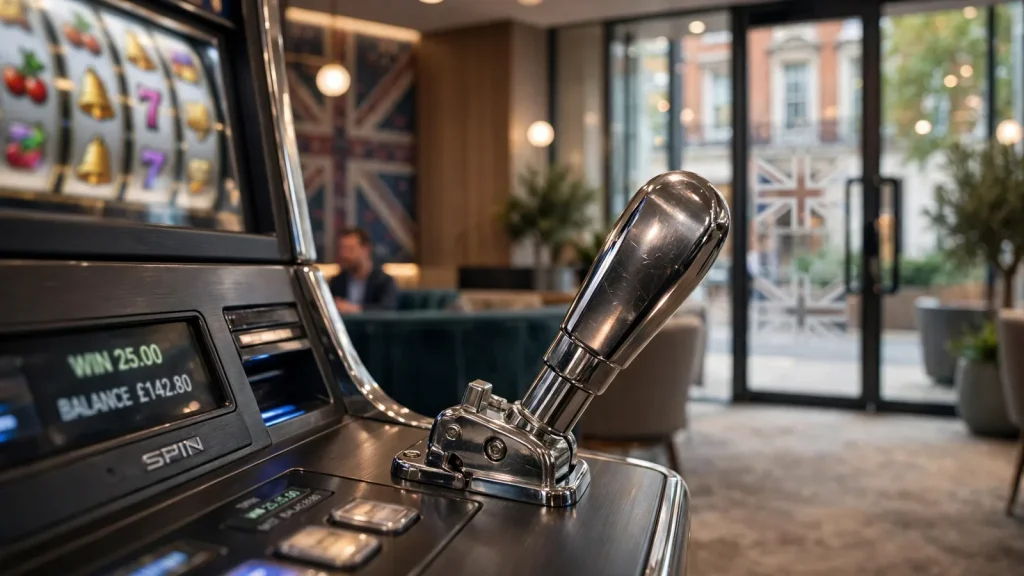
Online slot machines fall within the UK gambling regulatory system when they are offered to customers in Great Britain. The key question is not what type of game is being played, but whether the operator is supplying gambling services to people in that market. Operators serving customers in Great Britain must hold a licence from the UK Gambling Commission, wherever the business itself is based.
That means a slot game does not sit outside the rules simply because it is accessed through a website or app, or because the operator is established abroad. The operator’s location does not remove the licensing requirement when it serves customers in Great Britain. In practical terms, the regulatory reach follows the service being offered to the customer, rather than the physical location of the company or the label attached to the game.
This distinction also helps explain why an online slot at a site without a UK Gambling Commission licence is not a UK-regulated product merely because it is available to someone in Britain. An overseas licence may apply under another jurisdiction’s system, but it is not a substitute for the licence required to serve Great Britain. The two forms of oversight should not be treated as interchangeable.
The relevant market is Great Britain: England, Scotland and Wales. Northern Ireland has a separate legal framework, so the Great Britain licensing rule should not be casually applied to every part of the UK.
If you are trying to understand how slot machines are regulated, start by identifying the operator behind the site and whether it holds the required UK Gambling Commission licence for serving Great Britain. The fact that a game is described as a slot, or appears in a casino-style app, does not answer that question. Nor does a company’s overseas base settle it. What matters for this regulatory distinction is who provides the gambling service and which customers it serves.
The same principle applies across online casino games: regulation is tied to the operator’s activity in the market, not to a particular game format. So the useful check is not whether an individual slot looks familiar or carries a particular name, but whether the business offering it is licensed for the Great Britain market.
How to Check Who Holds a Casino Licence
A licence badge in a website footer is a claim, not proof. To establish who is responsible for a casino, start with its terms and conditions or “About” page. Find the operator’s full legal company name, the licensing authority and any licence number. A trading name or website brand may differ from the company name, so record both.
Casino Sites and Safety for UK Players
Next, open the regulator’s own public register rather than relying on a link or image supplied by the casino. Search for the company name or licence number and check that the entry is current. Confirm that the listed business is the same legal entity named on the site, and that the casino’s domain or brand is covered where the register provides that information. A similar name is not a match.
Check the licence expiry date and status as well. An expired, suspended or otherwise inactive entry does not show that the operator currently holds a valid licence. If the register and the casino’s claims disagree, or you cannot find an entry, do not treat the badge as confirmation. Contact the regulator using details from its official website if the discrepancy needs clarification.
Checking a UKGC licence
If a casino says it is licensed by the UK Gambling Commission (UKGC), use the Commission’s public register. Search for the operator, then compare the register entry with the company details and site domain shown by the casino. Make sure the entry is current and relates to the business behind the site, not merely a similarly named company. A UKGC badge alone cannot confirm those details.
For a site aimed at customers in Great Britain, the relevant check is whether the operator appears on the UKGC register with the appropriate current authorisation. A foreign regulator’s listing is not a substitute for that entry.
When the listing is overseas
Use the named overseas regulator’s own register and apply the same checks: legal entity, licence status, expiry date and any listed domains. Be cautious if the casino gives no company name, the register shows a different entity, or the regulator’s records cannot be verified independently.
A listing also has limits. For instance, an Anjouan entry should not be read as permission to serve customers in the United Kingdom: that jurisdiction’s licence excludes the UK and other restricted markets. The practical check is not simply whether a licence exists, but whether the public record matches the operator and the market the site claims to serve.
What a UK Gambling Commission-Regulated Casino Must Have
The defining requirement is a licence from the UK Gambling Commission (UKGC). If an online operator serves customers in Great Britain, it must hold that licence, whether its business is based in Britain or elsewhere. A company cannot avoid the rule simply by locating its offices or servers abroad.
That makes the operator’s relationship with the market more important than its address. A casino may describe itself as international or hold permission from an overseas jurisdiction, but those details do not replace the UKGC licence required to serve customers in Great Britain. The relevant question is not where the company is registered; it is whether it is offering gambling to people in this market.
For you, the distinction is practical: a site’s name, branding or claim to be “licensed” does not by itself establish that it is regulated by the UKGC. The licence must be from the Commission. A foreign authorisation is a separate status, issued under another jurisdiction’s rules, and should not be mistaken for British regulatory approval.
The rule applies to remote gambling operators regardless of where they operate from. So a business based outside Britain is not exempt when it serves customers here. Conversely, a company’s overseas address alone does not tell you whether it holds the required UKGC licence; the relevant point is whether it is serving the Great Britain market under that licence.
This is the basic test behind the phrase “casino regulated by the UK Gambling Commission”: the operator serving customers in Great Britain holds the Commission’s licence. If it does not, it is not UKGC-regulated, even if it has a licence elsewhere or uses wording that sounds reassuring. Keep those statuses separate when assessing what oversight applies to a casino.
What happens if I have a dispute with an Anjouan-licensed casino as a UK player?
You can complain to the operator, which must respond within 30 calendar days. Anjouan’s authority does not handle or decide player complaints, and these casinos do not have to offer an independent dispute-resolution route comparable to UKGC-approved ADR.
Are non-UK-regulated casinos legal for UK players to use?
Yes, UK law does not explicitly prohibit you from using a gambling service licensed abroad, and you do not commit a criminal offence simply by playing there. However, an overseas licence does not authorise an operator to serve customers in Great Britain; operators serving that market need a UK Gambling Commission licence.
What is the biggest risk of playing at a non-UK-regulated casino?
You have fewer protections if something goes wrong: Anjouan’s authority does not adjudicate complaints, and these casinos do not have to provide UKGC-style independent dispute resolution. Player funds are not guaranteed to be segregated, so you may be an unsecured creditor if the operator fails.
Are sites that are not on GamStop legal for players in the UK to access?
UK law does not explicitly prohibit you from using a gambling service licensed abroad, and you do not commit a criminal offence simply by playing there. But being accessible in Great Britain does not mean the operator is authorised to serve that market; operators serving it need a UK Gambling Commission licence.
Are gaming sites not on GamStop permitted for UK players?
UK law does not explicitly prohibit you from using a gambling service licensed abroad. However, sites not on GamStop are outside that scheme, and operators serving customers in Great Britain need a UK Gambling Commission licence.
Are Anjouan casinos connected to the GamStop self-exclusion scheme?
No. Anjouan-licensed casinos are not required to integrate with GAMSTOP.
Related posts

Terms of Use
UK Casino Sites and Slots: Licensing and Play